The form should force seven answers. Each one earns a real decision.
First, what business problem are we solving. Not "an AI assistant for support." That is a tool category. The answer must name the broken work, the baseline, and the cost of leaving it alone.
Second, who owns the outcome. Not the person excited about AI. The owner is the person who can tell the team to change the workflow on Monday morning and who will still own the result when the novelty has worn off. If there is no such person, reject the request. A committee is not an owner.
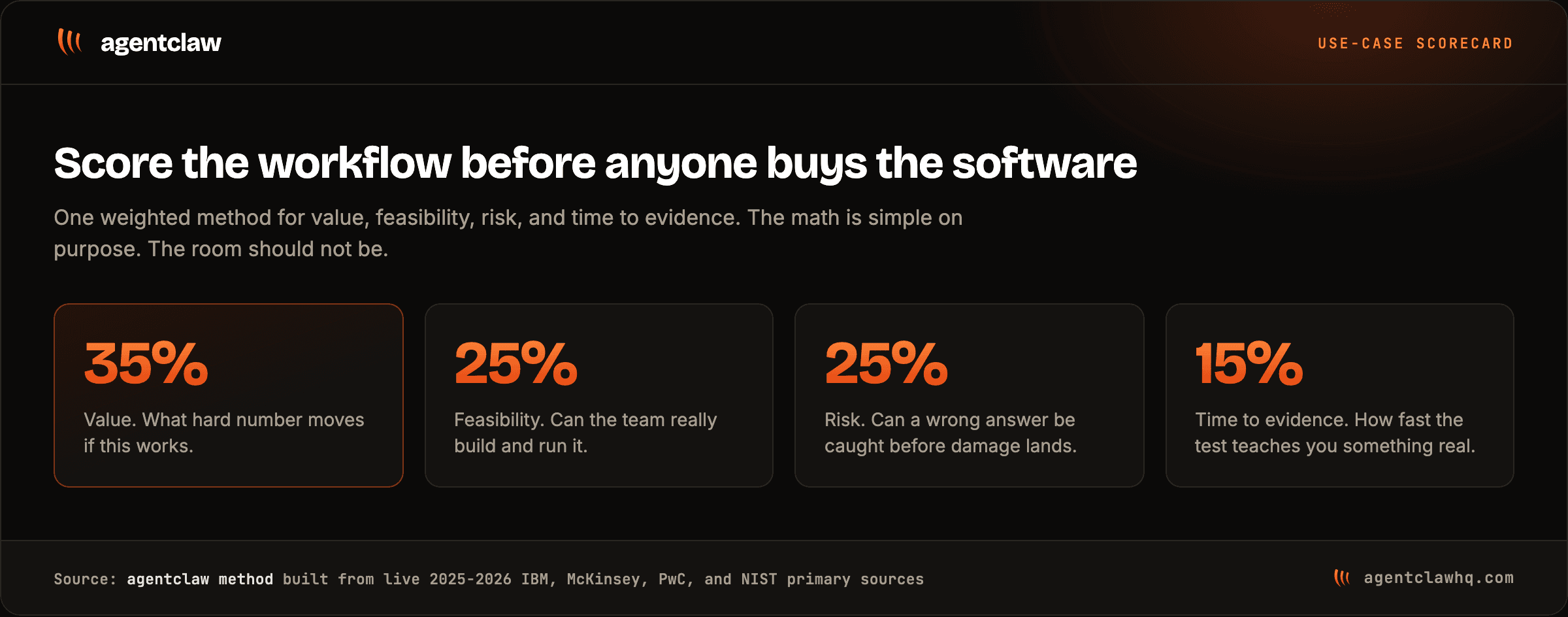
Third, what exact workflow is in scope. One workflow, one user group, one output. Gartner's July 31, 2026 roadmap guidance is blunt about the need to invest in foundations around value management, organization, governance, engineering, and data rather than treating AI as a tools exercise. Intake is where that discipline starts.
Fourth, what data will the system touch. That means systems, permissions, sample access, refresh rate, and the system of record. If the team cannot reach representative data inside ten working days, they are not asking for an AI build yet. They are asking for a data cleanup or integration project.
Fifth, what evidence threshold would make this worth funding next. State the measure, target, review window, and stop rule in writing. KPMG's June 24, 2026 Global AI Pulse found organizations with strong cost visibility are five times more likely to report established ROI, 15% versus 3%. You do not get cost visibility after the fact. You design for it during intake.
Sixth, what happens when the output is wrong. The requester should say how the mistake is caught, who handles escalation, what action is reversible, and when a human must approve. If the only answer is "we'll monitor it," the request is still a sketch.
Seventh, what next decision are we asking for right now. Reject, return for evidence, park, fund discovery, or approve a bounded pilot. One request, one decision. Otherwise the form becomes an idea dump and the roadmap inherits the sorting job.